

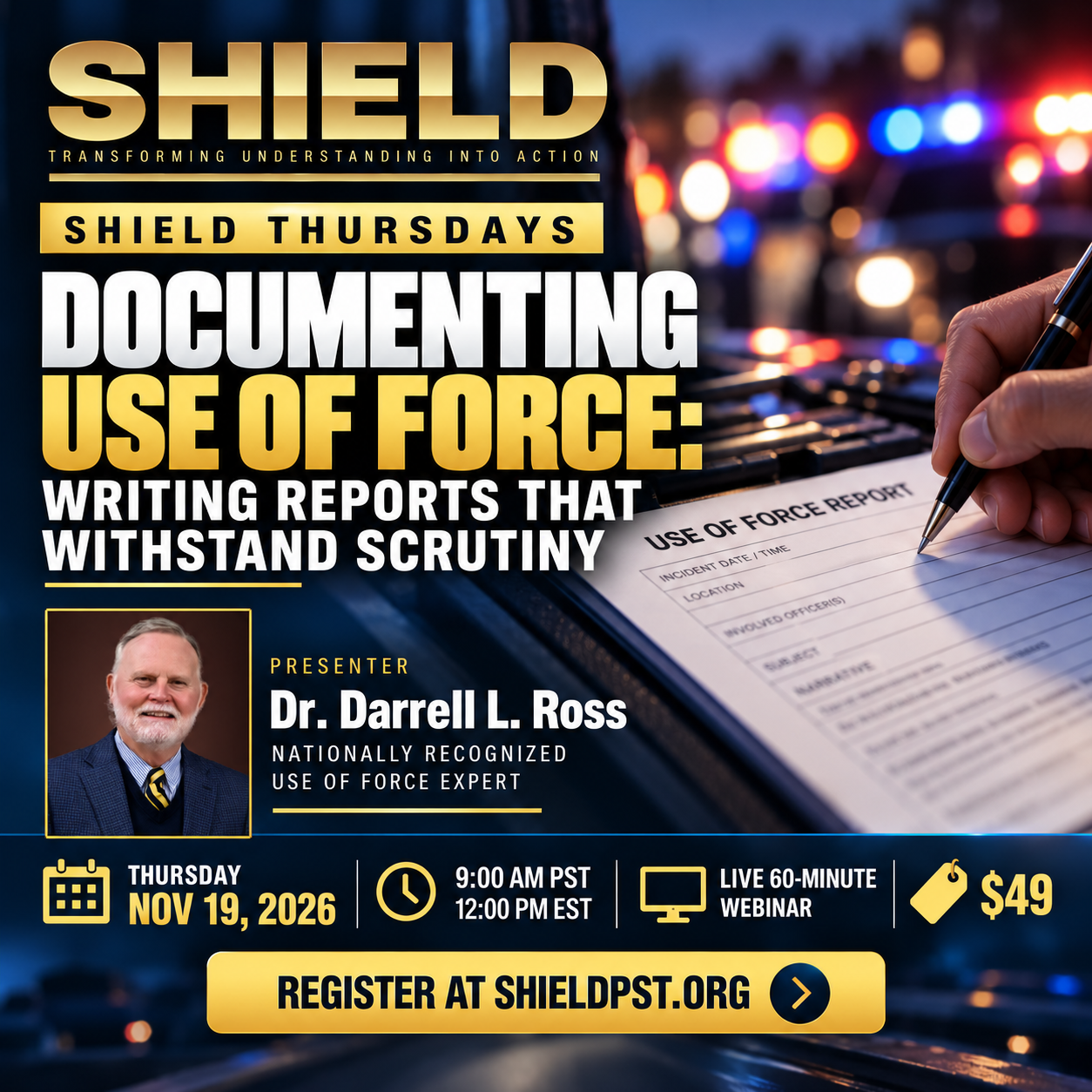
Documenting Use of Force
Writing Reports That Withstand Scrutiny
Presented by Dr. Darrell L. Ross
Nationally Recognized Use of Force Expert
REGISTER NOW — $49About This Webinar
Using force is only part of the job. Explaining it is the other part.
A use of force report is often the first document a supervisor reviews and the first exhibit a plaintiff's attorney examines. It may become a critical piece of evidence in an administrative investigation, a civil rights lawsuit, or a criminal inquiry.
Even when an officer's use of force is reasonable and lawful, an incomplete or poorly written report can undermine the ability to explain and defend the officer's actions.
Boilerplate language, conclusory statements, vague descriptions, and missing details can create questions about an incident that might otherwise have been readily addressed through accurate contemporaneous documentation.
During this practical, one-hour Shield Thursdays webinar, nationally recognized use of force expert Dr. Darrell L. Ross examines the essential elements of effective use of force documentation.
The session focuses on accurately documenting what the officer perceived, knew, and did at the time force was used, while explaining how well-written reports support supervisory review, administrative investigations, and subsequent litigation.
The goal is not to make an unreasonable use of force appear justified. It is to ensure that the written record accurately and completely explains the facts and circumstances surrounding the officer's actions.
Why You Should Attend
The quality of a use of force report can significantly influence how an incident is evaluated by supervisors, investigators, attorneys, judges, and juries.
Understanding how to document force decisions is essential for both officers who use force and supervisors responsible for reviewing those incidents.
Strengthen Report Quality
Learn how to replace vague or conclusory descriptions with specific, objective facts that accurately communicate the circumstances surrounding a force encounter.
Improve Legal Defensibility
Understand how thorough documentation helps establish the factual context necessary to evaluate force under applicable constitutional standards.
Reduce Unnecessary Liability Exposure
Identify reporting deficiencies that can complicate investigations, weaken an agency's legal position, or create avoidable questions during litigation.
Improve Supervisory Review
Recognize what supervisors should look for when evaluating reports, identifying missing information, and determining whether further investigation is necessary.
Address Video Evidence
Examine the relationship between written reports, body-worn camera footage, witness statements, and other evidence collected during force investigations.
Promote Accountability
Support accurate, transparent documentation that helps agencies evaluate officer conduct, identify training needs, and maintain public confidence.
What You Will Learn
This webinar provides practical guidance for documenting use of force incidents in a manner consistent with constitutional standards, sound investigative practices, and professional report-writing principles.
- Applying Graham v. Connor: Understand how objective reasonableness, the perspective of a reasonable officer on the scene, and the totality of the circumstances inform effective use of force documentation.
- Documenting Officer Perceptions: Identify the observations, information, and circumstances known to the officer when force decisions were made.
- Describing Subject Behavior: Explain the importance of documenting specific subject actions, resistance, threats, and other relevant conduct rather than relying on generalized labels.
- Articulating Threat Assessments: Learn how to explain the facts supporting an officer's assessment of danger and the decisions made in response.
- Avoiding Common Reporting Errors: Recognize boilerplate language, vague terminology, conclusory statements, incomplete timelines, and other documentation deficiencies.
- Addressing Body-Worn Camera Evidence: Understand how written accounts relate to video recordings, witness observations, and other available evidence.
- Understanding Supervisory Responsibilities: Examine the supervisor's role in reviewing reports, identifying deficiencies, and ensuring appropriate follow-up investigation.
- Preparing for Legal Scrutiny: Understand how attorneys, courts, and juries may evaluate use of force documentation during litigation.
Who Should Attend?
This program is designed for professionals responsible for using force, documenting force incidents, reviewing officer conduct, investigating complaints, or defending agency actions.
Whether you are writing the initial use of force report, reviewing it as a supervisor, or evaluating it during an investigation or lawsuit, this webinar provides practical information relevant to your responsibilities.
Meet Your Presenter
Dr. Darrell L. Ross
Professor Emeritus of Criminal Justice
Valdosta State University
Dr. Darrell L. Ross is a nationally recognized authority on the use of force in law enforcement and corrections. His extensive professional experience includes correctional operations, criminal justice education, training, research, and litigation consulting.
He began his career with the Michigan Department of Corrections, serving in several positions including correctional officer, supervisor, probation officer, and academy instructor.
From 1992 to 2006, he taught criminal justice at East Carolina University. He later served as a professor of criminal justice at Valdosta State University.
Dr. Ross has authored five books and more than 95 articles, book chapters, and monographs examining issues involving use of force, human factors, officer-involved shootings, civil liability, restraint practices, and custodial deaths.
His publications include Civil Liability in Criminal Justice and Civil Liability Issues in Corrections.
He has delivered more than 500 national and international presentations and has served for more than three decades as an expert witness involving police use of force, in-custody deaths, officer-involved shootings, internal affairs investigations, and related policy and training issues.
Documenting Use of Force
Writing Reports That Withstand Scrutiny
Thursday, November 19, 2026
9:00 AM PST / 12:00 PM EST
Live 60-Minute Webinar
Presented by Dr. Darrell L. Ross
Shield Public Safety Training, Inc.
Transforming Understanding Into Action