

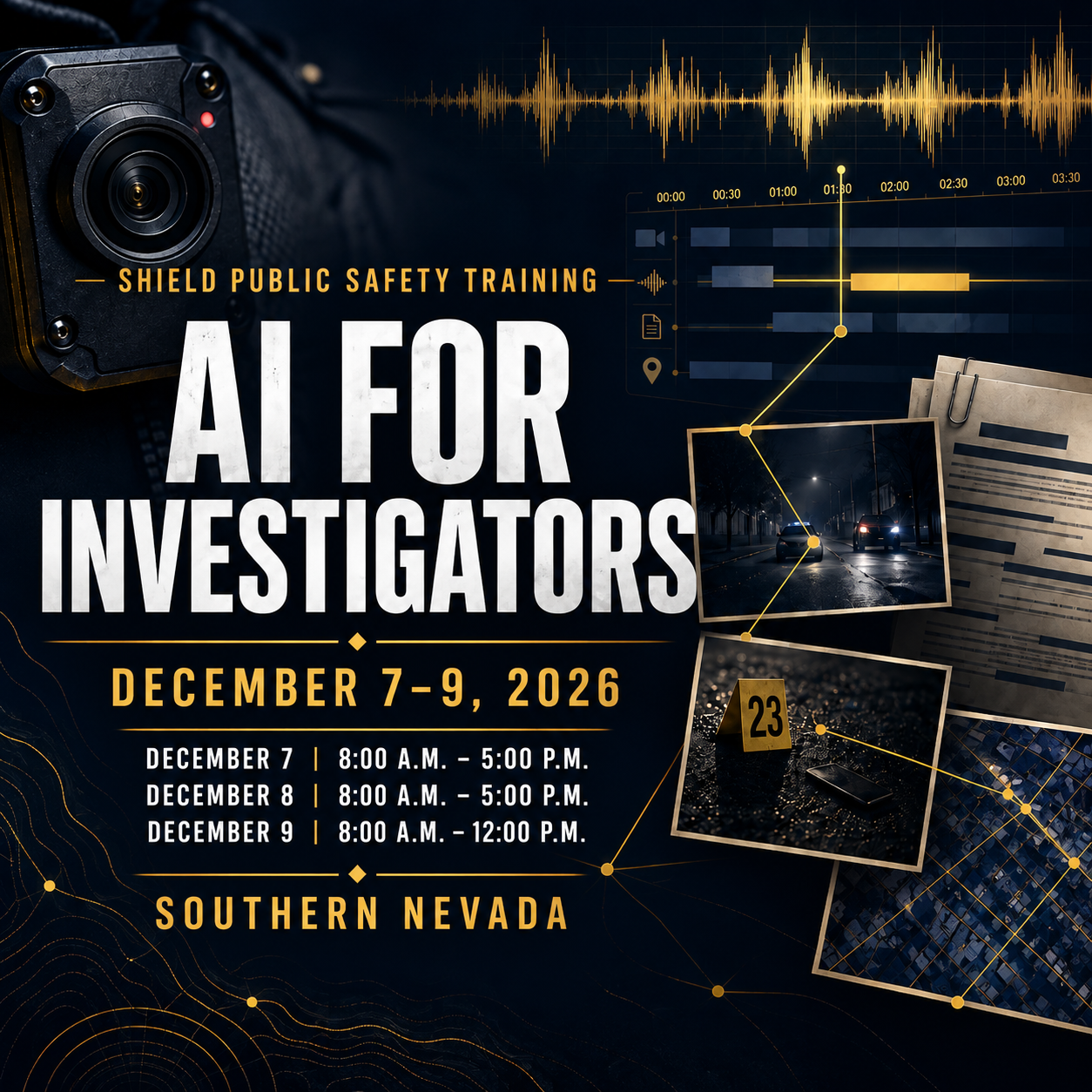
AI for Investigators
Practical Applications for Criminal and Administrative/Internal Investigations
Learn how AI platforms can help you organize information, review reports, prepare for and conduct interviews, and work with audio, photographs, and video. Then apply what you learn to a realistic mock case file.
Register Now → View Training CalendarRegister early and secure your seat.
Per attendee when registered by October 30, 2026.
Per attendee beginning October 31, 2026.
Three attendees from the same agency through October 30. The three-person rate is $1,585 beginning October 31. Additional attendees from the same agency are $395 each.
Registration includes
Learn to use AI as part of your investigative work.
AI can help you organize information, build timelines, compare accounts, identify unanswered questions, prepare interviews, review photographs and video, and plan investigative next steps. It can also make mistakes, overlook important information, or present unsupported conclusions.
This is an introductory program into the use of AI for investigations. It explains what AI can and cannot do and shows you how to check its work. Day 1 introduces AI platforms and practical investigative uses. During Days 2 and 3, you will apply those skills to one mock case involving both criminal and administrative/internal investigations.
What you will learn
No prior AI experience or programming knowledge is required. You will learn how to:
- Understand what AI can and cannot do during an investigation.
- Draft clear prompts to assist with investigative tasks.
- Use AI platforms to organize and review case information.
- Build and check investigative timelines.
- Compare reports, statements, audio, photographs, and video.
- Identify missing information and questions requiring follow-up.
- Prepare for and conduct interviews.
- Apply AI tools during criminal and administrative/internal investigations.
- Recognize inaccurate, incomplete, or unsupported AI results.
- Check AI results against the original information.
- Protect confidential and sensitive information.
- Document how AI was used during an investigation.
Work through a realistic mock case file.
You will receive case information in stages and use it throughout the hands-on exercises.
Three days of guided, hands-on learning
Foundations, Tools & Investigative Methods
Welcome, Orientation & the Mock Investigation
Course goals, faculty introductions, an overview of the mock case, and how the practical exercises will work.
How AI Can Help With an Investigation
A plain-language introduction to AI platforms, common investigative uses, basic limitations, and the investigator’s continuing responsibility.
AI Concerns During Investigations
Inaccurate answers, made-up information, missed information, bias, privacy, confidentiality, security, discovery, and record preservation.
Drafting Prompts to Assist Your Investigation
Learn how to tell an AI platform what information to review, what task to perform, and how to present the result.
Using AI for Multi-Step Investigative Tasks
Learn how to divide a larger assignment into manageable steps, check the work at each stage, and keep the investigator in control.
Introduction to AI Platforms for Investigations
Learn how AI platforms can help organize reports, transcripts, policies, and other case information—and how to check the answers against the original material.
AI-Assisted Video & Image Analysis
Learn how AI may help review body-worn-camera footage, surveillance video, and photographs; locate relevant portions; compare recordings with reports; and identify items requiring human review.
Working the Mock Case: Organizing Information and Planning the Investigation
Case Briefing & Team Assignments
Receive the mock case file, review the initial information, establish team roles, and learn the rules for using and documenting AI.
Practical 1: Organizing the Case Information
Review and organize the case materials, identify missing items, record the sources, and outline the first investigative steps.
Practical 2: Building the Case Timeline
Use reports, dispatch information, 911 audio, and video to place events in order, check differences in timing, and identify questions requiring follow-up.
Practical 3: Comparing Reports, Statements & Other Information
Compare accounts, recordings, photographs, and records to identify agreements, differences, and unanswered questions.
Practical 4: The Investigative Plan
Decide what should happen next and prioritize interviews, records, video, follow-up contacts, and tasks requiring direct human investigation.
Practical 5: The Interview
Prepare questions, conduct a mock interview, assess the new information, and identify necessary follow-up.
Faculty Review & New Case Information
Compare approaches, discuss helpful and inaccurate AI results, and receive additional information for Day 3.
Criminal & Administrative/Internal Investigations: Same Tools, Different Rules
Using AI in Criminal and Administrative/Internal Investigations
Learn how the same AI tools can assist both types of investigations while respecting their different purposes, legal requirements, and information-handling rules.
Practical 6: Keeping the Investigations Separate
Using the mock case, decide what information may be used in the criminal investigation, what may be used in the administrative/internal investigation, and what must remain separate. Then prepare separate next-step plans for each investigation.
Practical 7: Preparing Investigative Work Products
Use AI to assist with selected products such as a verified timeline, interview plan, investigative summary, status report, and list of remaining tasks. Every item must be checked against the original information.
Team Presentations & Case Review
Explain your investigative approach, how AI was used, which results were corrected or rejected, and what work remains.
Bringing AI Into Your Agency
Appropriate uses, human review, confidentiality, information security, documentation, supervision, policy, training, and final lessons.
Use AI—and keep the investigator in control.
Every exercise reinforces accuracy, confidentiality, proper information handling, and human review.
Legal, investigative, training and decision-making experience
The faculty combine public-safety law, investigations, training, human performance, use-of-force analysis, decision-making, and responsible use of AI.
James E. “Jeb” Brown, Esq.
President · Shield Public Safety TrainingAttorney representing law-enforcement agencies for more than 30 years, with extensive experience in constitutional policing, internal affairs, administrative investigations, policy, training, civil liability, and emerging public-safety technology.
John G. Peters, Jr., Ph.D.
Co-Founder · Shield Public Safety TrainingNationally recognized law-enforcement trainer, author, consultant, and expert whose work addresses use of force, human performance, instructor development, policy, decision-making, and public-safety operations.
John R. Black, D.B.A.
President · Aragon National, Inc.Retired law-enforcement lieutenant with more than 23 years of experience in patrol, investigations, corrections, training, and command. His work includes use-of-force analysis, administrative review, video analysis, sensemaking, systems thinking, and decision-making.
Designed for personnel who investigate, supervise, review, train or advise
No AI experience or programming background is required. You must bring a laptop computer capable of downloading information.
- Criminal investigators and detectives
- Internal affairs and professional standards investigators
- Use-of-force and officer-involved-shooting investigators
- Investigative supervisors and command staff
- Digital-media and body-worn-camera personnel
- Agency counsel, prosecutors and municipal attorneys
- Training and policy staff
- Risk-management and technology personnel
Learn it. Apply it. Take it back to your agency.
Enrollment is limited to preserve the hands-on format, small-group exercises, and direct interaction with the instructors.
Program content, practical-exercise materials, and agenda sequencing are subject to refinement. AI platforms and capabilities may change before the program. You remain responsible for complying with applicable law, agency policy, confidentiality requirements, information-handling requirements, and approved technology-use rules.