

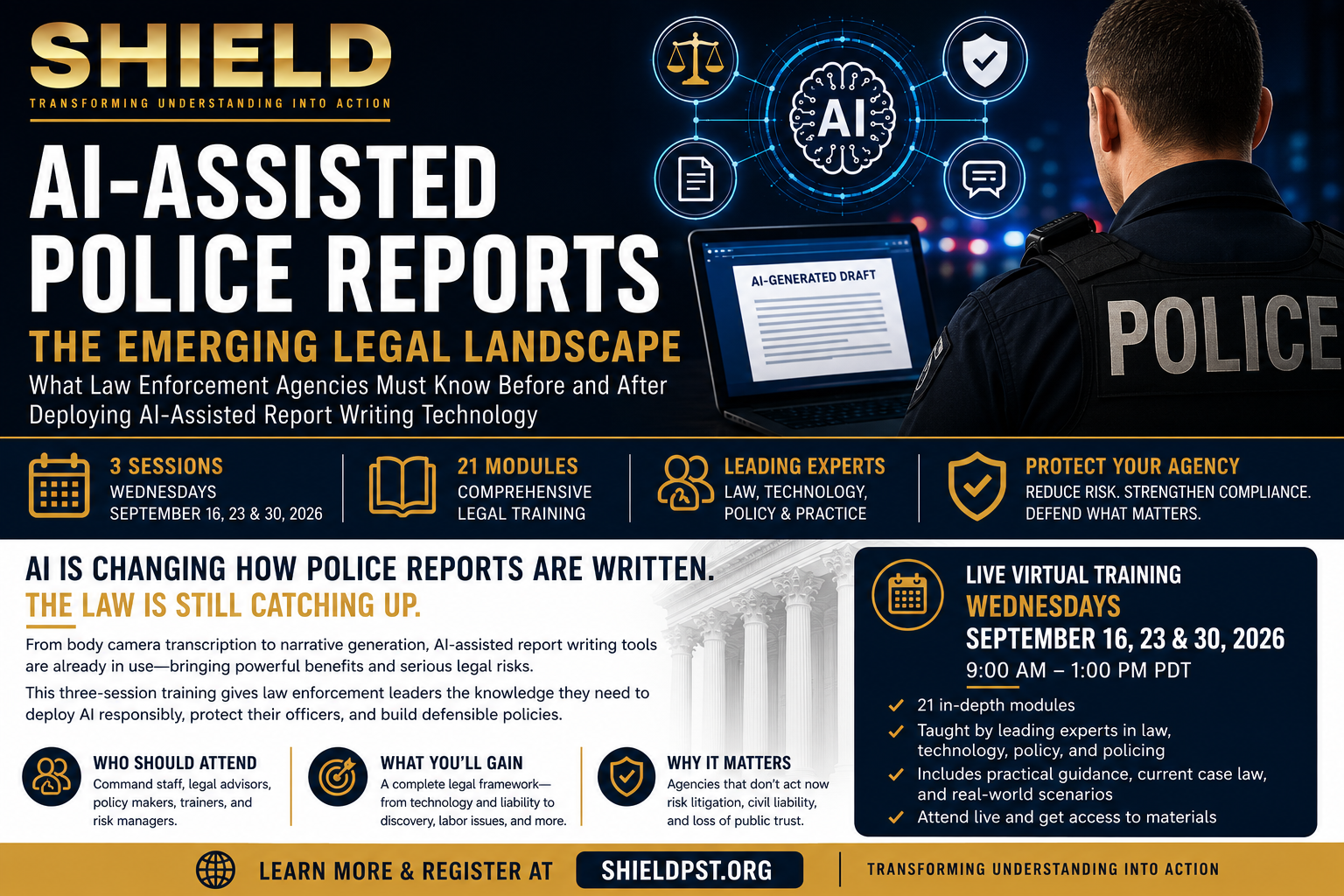
AI-Assisted Police Reports:
The Emerging Legal Landscape
AI-assisted report-writing technology can reduce administrative workload and accelerate report preparation. It can also introduce inaccurate facts, omit critical information, distort witness statements, create conflicts with body-worn camera footage, and expose agencies to new discovery, evidentiary, labor, privacy, disciplinary, and civil-liability risks.
Program Overview
AI-assisted report-writing technology is already changing how law-enforcement agencies document incidents. The operational benefits are real. So are the legal, evidentiary, supervisory, labor, privacy, and risk-management questions.
This comprehensive live virtual program examines the full lifecycle of an AI-assisted police report—from the technology that generates the first draft through officer verification, supervisory review, records retention, discovery, internal affairs, courtroom testimony, policy development, training, and agency implementation.
Presented in three four-hour sessions, the program includes 21 focused modules addressing the issues agencies must confront now—not after an AI-generated report becomes the subject of a suppression motion, Brady demand, public-records request, disciplinary investigation, or civil lawsuit.
Registration and Tuition
Sending an agency team allows command, legal, training, supervision, records, technology, and risk-management personnel to receive the same guidance and begin developing a coordinated implementation strategy.
Faculty
This intensive three-part program brings together attorneys, law-enforcement executives, policy specialists, trainers, and nationally recognized subject-matter experts to examine the legal, operational, evidentiary, supervisory, and policy implications of AI-assisted police reporting.
Program Schedule
Technology, Risk & Constitutional Foundations
How AI-assisted report-writing tools work and why different systems create different risk profiles. Topics include hallucinations, transcription failures, bias, unauthorized “shadow use,” the gap between AI-generated drafts and final reports, officer verification, supervisory responsibility, municipal liability, discipline, and command-level risk.
Evidence, Discovery & Emerging Disclosure Obligations
Brady and Giglio obligations, preservation of AI drafts and metadata, spoliation, public-records requests, authentication, chain of custody, Franks challenges, confrontation issues, victim privacy, CJIS compliance, internal affairs investigations, prosecutorial ethics, and post-conviction exposure.
Labor, Courtroom Practice, Policy & Agency Action
Labor-relations and meet-and-confer obligations, ADA and disability-related documentation issues, civil and criminal trial strategies, officer testimony, cross-examination, policy development, officer and supervisor training, phased deployment, auditing, emerging standards, and the next generation of AI-related litigation.
What Participants Will Learn
Technology & Verification
- Evaluate the legal and operational risks of specialized and general-purpose AI tools.
- Establish meaningful officer-verification and attestation requirements.
- Create supervisory-review protocols that go beyond grammar and formatting.
- Prepare officers to testify accurately about their use of AI.
Evidence & Disclosure
- Preserve AI drafts, metadata, audit logs, and vendor records.
- Respond to Brady, Giglio, discovery, public-records, and litigation demands.
- Protect confidential victim, juvenile, disability-related, and criminal-justice information.
Labor, Policy & Governance
- Address labor and meet-and-confer obligations before deployment.
- Develop defensible policies, training programs, auditing systems, and vendor safeguards.
- Identify what prosecutors and agency counsel need to know about AI-assisted reports.
Risk Reduction
- Identify what agency policies, contracts, and training programs must address.
- Reduce the risk of suppression, discipline, credibility findings, civil liability, and reputational harm.
- Build a coordinated implementation strategy across agency functions.
Who Should Attend
This program is designed for personnel responsible for approving, implementing, supervising, reviewing, defending, or regulating AI-assisted police report-writing technology, including:
- Police chiefs, sheriffs, and command staff
- Patrol, investigative, and corrections supervisors
- Agency counsel and municipal attorneys
- Prosecutors and prosecutorial agency leadership
- Internal affairs and professional standards personnel
- Training managers and field-training personnel
- Records, evidence, and public-records personnel
- Risk-management and compliance professionals
- Labor-relations professionals
- Information technology, procurement, and vendor-management staff
- Personnel responsible for body-worn cameras, CAD, RMS, and digital evidence systems
The Benefit of Sending an Agency Team
AI-assisted report writing affects multiple parts of an organization. Command staff may approve the technology. IT personnel may manage the system. Supervisors review reports. Officers certify them. Records personnel receive disclosure requests. Prosecutors rely on them. Agency counsel may ultimately be required to defend them.
When these personnel attend together, they develop a shared understanding of:
- What the technology does and what can go wrong
- What information and system records must be preserved
- What officers and supervisors must verify
- What prosecutors and agency counsel need to know
- What agency policies, contracts, training, and auditing must address
A coordinated agency team is better positioned to identify gaps, assign responsibility, and implement a consistent response after the training.
Prepare Before the First Challenge Arrives
Do not wait for the first AI-related subpoena, suppression motion, disciplinary case, public-records request, or civil claim to determine whether your agency’s policies, training, contracts, retention practices, and review protocols are defensible.
Register now and prepare your agency for the emerging legal landscape of AI-assisted police reports.
Register for the Program →